She/Her
Iosefka
De Vita
(Pronounced yo-SEFF-kuh)
Transfemme and lesbian author.
Writes colorful dark fantasy and horror, with a glimmer of hope.
Find me
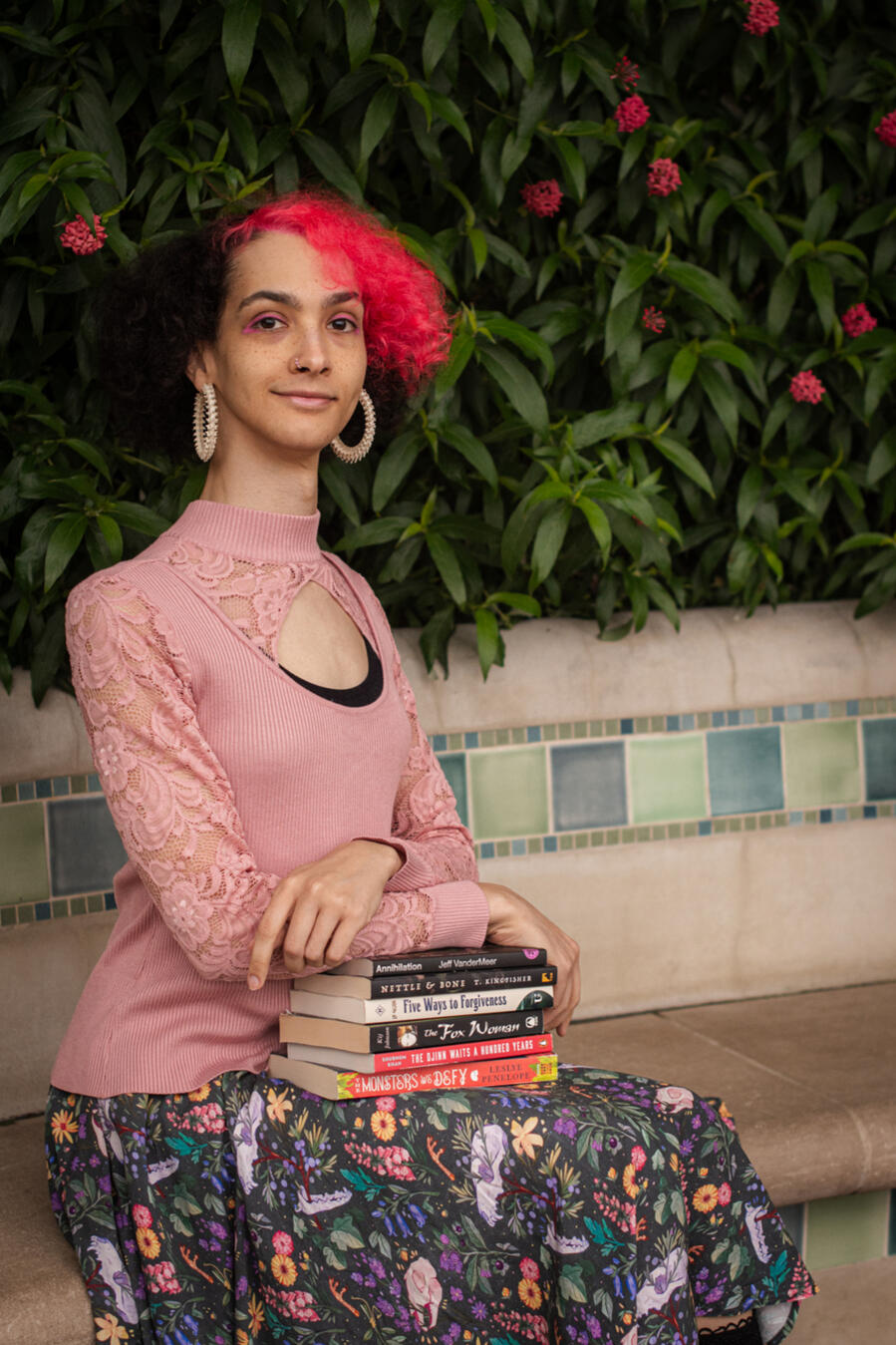
Iosefka De Vita (or Sefka) is a half-Black, half-Italian transfemme author living in Pennsylvania with her wife, eight cats, four chickens, three snakes, and a planted aquarium with several shrimp, snails, and fish.Under her deadname, she graduated from Rice University with a B.A. in English. She was exposed to a wide range of cultures from a very early age, including French, Persian, and various African diaspora, and has always loved the animals others find repulsive. Her work explores intersectionality and displacement, complex psychology, and difficult moral questions through the lens of a lush fantasy setting, with touches of science fantasy, cosmic and body horror, and love of all kinds.
She believes in handling all cultures she's inspired by with respect, as borrowed pieces of other people's lives. She is constantly questioning ideas she takes for granted and interrogating her own biases, and wants to challenge herself with proper representation as much as she challenges her readers.Iosefka is especially fascinated by fantasy ecology, the intricacies of language (particularly endonyms and exonyms), and non-didactic storytelling. She refuses to write someone with a horse as a mount. When she isn't burning her eyes out doing research or spending an hour editing a single paragraph, she can be found reading, playing obscure and vintage games, or watching video essays analyzing games and literature.
WHAT'S COLORFUL DARK FANTASY?
The dark fantasy genre is usually characterized by both dark, heavy themes and gloomy, gritty imagery to match. "Colorful dark fantasy" is meant to convey that the dark themes are not matched by the setting and visuals, which may be bright and vibrant despite the horrors that occur within them. It can also be thought of as dark fantasy stories that take place in high fantasy worlds.
AI USAGE
Iosefka is solidly against generative AI usage in creative spaces. Her work does not use generative AI at any point in the creative process, including conceptualization, research, drafting, editing, proofreading, or visual art elements.
Support human creators, no matter what.
NOVELS
Fire to Flowers (Querying)
Can someone driven by hate and nourished by suffering truly be a good person?After 300 years of heartbreak and scorn, Tiferet, an elven warlock, once wanted to burn her people's "utopia" to ash. That was before the interstellar Nightmare invaded their world, killing and resurrecting Tiferet as a vampiric alukah. Driven by a greater hatred for the cosmic force that stole her life, she now fights the Nightmare alongside the elves and searches for a cure to her alukah curse - all while hiding her true nature behind a bright, smiling mask.Only one woman knew and kept her lethal secret: Hyaecinthe, Tiferet's late lover and only friend…whose blood is on Tiferet's hands. When Hyaecinthe's restless spirit returns, demanding to know the fate of her lost daughter, guilt and heartache drag Tiferet into a journey of penance.A journey she must take alongside Casimir, a holy knight sworn to destroy the Nightmare - because he's possessed by Hyaecinthe's spirit. Tiferet knows that Casimir shares some of Hyaecinthe’s memories, but how much does he know about Tiferet?As Tiferet travels with Casimir across the divine elven empire of Tron Daurat and the horrific Nightmare, she pries back his distrusting shell to deduce what he's inherited. To her surprise, she finds herself drawn to the person she sees underneath - but is that person Casimir, or Hyaecinthe? And as she lowers her own walls to gain Casimir's trust, she's forced to confront the centuries of trauma that led to her betrayal of Hyaecinthe.And the longer Tiferet starves her curse’s hunger for blood and pain, the harder it becomes to hide the beast under her skin.
Death to the Dread Star (WIP)
Inspired by pre-Heian Era Japan: a shaman hunts the centipede demon she was supposed to be sacrificed to seal away.
SHORT STORIES
A Droplet in Stillness (Unpublished)
An Eidolon in a featureless eternity is forced to confront the concept of change.
The Curse of Want (Unpublished)
A frail ruler discovers he can overcome his deficiencies through cannibalism.
Links to various supplemental material.
ESSAYS
BLUESKY THREADS
Responses to various worldbuilding/prompt events.
- #MayWorldbuilders 2026
- #JuneWorldbuilders 2026
- #JulyWorldbuilders 2026
- #SummerOfStories 2026
- #PretendPanel 2026
- #LGBTQWriteAThon 2026
PLAYLISTS
Playlists for various characters and stories.
(Coming soon??)
Language and Anachronism in Fantasy
A warning: I'm going to talk about swearing here. There will be use of some harsh language for demonstrative purposes, but I will not be using slurs and the like.I was watching Meredith Novaco's video on accuracy of translations of the Odyssey (highly recommended, btw) and it got me thinking about my own writing. I'm a very, very slow writer. I'll agonize over individual word choice and sentence structure while I'm editing, sometimes for way too long. As a result, I'm constantly thinking about why I choose certain words, what they convey about the character, the setting, the language, and what impact my choices have on a reader.I've had some comments on my work regarding my use of language, mostly in dialogue, pulling a reader out of the story. These mostly revolve around a feeling of anachronism: something that makes them acknowledge "I'm experiencing a world created by a person in (insert year), not the accurate recounting of events that (I am made to believe) really happened." I don't use hyper-contemporary words in my prose ("definition" was cited as one, for example, due to feeling too "clinical" for a fantasy setting), but it still hits some readers in a weird way.And while I've stood by most of my language choices, it's an interesting topic to analyze - and I think it overlaps heavily with the techniques translators use when determining how literally to translate between languages. Everyone brings up how Tolkien said he viewed himself as translating stories from Middle Earth into his contemporary English, but I haven't seen discussion on how that can apply to authors in the broader speculative fiction genre. It's helped me with my own work; maybe it'll help you, too!A disclaimer before I start rambling: I am not a translator. I'm not multilingual. I have a deep appreciation for the nuances of language, but I can barely read a little French or Italian. These are thoughts based on my own critical analysis of writing and debates I've observed between professional translators, whether that's for Homeric works or modern anime. Please do your own research on these topics for a professional perspective.So: anachronism in speculative fiction and accuracy in translation. In both cases, the writer/translator is attempting to convey a world and language and emotions the reader cannot understand on their own, whether due to a language barrier or a reality barrier (or both, depending). Both are faced with a difficult question: how "authentic" should their presentation be? How much of the original terminology and unique phrasing should be shown to a reader? How much unique terminology should be simplified to terms that their average audience can be expected to understand, and how much should be presented unaltered from its original state?Essentially, an author has to intimately understand two different perspectives: that of their character in this fictional world, and that of a theoretical reader in the real world.I personally, as a writer and reader, want to feel like I'm experiencing a culture and world that's different from my own. I also want to ensure that any parts of the real world that I draw inspiration from are handled with respect, as if they were pieces of my own life. At the core of everything, though, I am writing about people. No matter my reader's background, I want to place them in a character's shoes for the duration of a story, and make them feel what the character feels as closely as I can.This means that my readers must also understand an unfamiliar culture, ideology, customs, way of living, and so on, because all of these impact who a person is and how they navigate the world. I feel that presenting my worlds as "foreign" to a reader will create distance; to the character, all the fantastical stuff happening around them is as normal as cars and computers are to us. In Fire to Flowers, for instance, I need the reader to be comfortable in the shoes of a 300-year-old elven woman living in a 6,000-year-plus isolationist, classist, post-scarcity utopia. I'll look at three areas where I personally make decisions on how to execute that: place names, item names, and swearing.Yes, I think about vulgarity in fictional worlds all the time. It's fascinating!But first, place names. The protagonist of Fire to Flowers, Tiferet, is fluent in Elvish (French), but not in Old Elvish (Occitan) or Draconic (Hebrew): the former is similar to a modern English-speaker trying to read Old English, while the latter is a religious language to the elves, similar to the Catholic use of Latin. So she wouldn't think of Tron Daurat as "Golden Throne" or Tzalmavet as "Shadow of Death" because, while they're near-literal translations, those aren't languages she speaks. Easy enough, right?
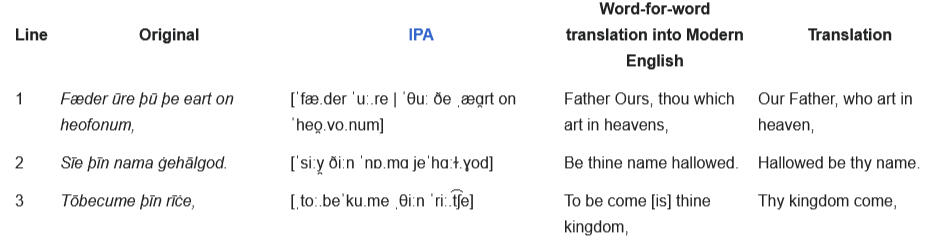
So why, in her narration, do I have Tiferet think of Val Sans Retour as "Valley of No Return" instead of the Elvish term? Someone outside of Tron Daurat would interpret it as "Val Sans Retour" because, to them, it's a foreign location in a foreign language; for her, it's equivalent to how an English speaker thinks of Death Valley.Then what about the city Chevrefoil, which literally translates to "honeysuckle"? Well, look at Tokyo: 東京 cleanly translates to "Eastern Capital," but I don't believe native Japanese speakers think of it as "Eastern Capital." Context and colloquial usage don't always take into account direct transliteration, because that's just the way people speak and conceptualize the world around them.Okay, cool, so what about the terms "sweetblood" and "gemmoire"? Both are derived from Elvish, but Tiferet translates one in her mind and not the other. This, again, is cultural context: sweetblood is commonly understood to be the fermented blood of lamb-fruit, a "what it says on the tin" deal, so she wouldn't think of it as sangsucré even though I know that's the literal term she's using. Gemmoire, meanwhile, is a colloquial shortening of the Elvish "gemme de memoire," which translates literally to "memory crystal." But people don't normally say "compact disk"; even in other languages, they usually say "CD."Even then, sometimes there just aren't good analogues. This is especially a challenge for me when it comes to describing clothing or food, and one I'm honestly still working on. I generally lean toward helping the reader understand unfamiliar terminology as efficiently as possible rather than potentially giving a reader space to imagine the world or characters as ethnicities I don't intend. I wouldn't call a Punjabi kurta a long shirt and leave it at that, for example.In summary, context and colloquial understanding determine how we conceptualize the world around us, and those outrank literal definitions nine times out of ten. Which makes deciding what to directly translate and what to preserve an extremely case-by-case situation - but hey, writing is about guidelines, not hard rules.So we're finally at the swearing portion, every fantasy author's favorite (or least favorite) worldbuilding tool! I've come up with in-world curses and sayings, but I also regularly use real-world curses like "shit" or "fuck." Why not make more "Elvish" versions of those instead?Unlike the practical, conceptual decision-making behind place or object names, this gets into a much more difficult topic around the psychological manipulation that pretty much all art does. Art in all forms is intended to provoke an emotional response, and stronger responses have a very small window in which they can be provoked. The issue is that these reflexive emotional responses are conditioned by a lifetime of experiences and social interactions, and I have a relatively minuscule amount of time to emotionally condition a reader. If I don't use that time effectively, the moment won't land, and then it passes. There's no second chance there.A joke isn't funny if you have to explain it afterward.In the same vein, if I need a reader to immediately understand that a character is being incredibly vulgar or impolite, I can get the reader to understand that over time by showing them how the culture works; but it's difficult to impossible to make the reader feel that visceral twitch you get when you hear someone acting inappropriately by going that route. A reader just hasn't been socially conditioned for their entire life in the exact same way that the character has been. So if my goal is to put the reader emotionally in the character's shoes, I feel I need to make compromises.Let's finally look at an example that one of my readers pointed at (with context removed to avoid spoilers). A character finally has the opportunity to freely express a mountain of deep-seated loathing they've built up for one specific person. Which of the following quotes makes you, personally, feel that hatred more?"You disgusting demon-spawn."
"You rancid fucking whore."I'd imagine it was the second one.Technically, elven culture is very sex-positive, so the sex-shaming element of the word "whore" as we understand it in our world wouldn't develop in Tron Daurat. However, even in our world, we use the term to violently degrade someone lacking in integrity or morals, an aggressive and vicious condemnation of someone's fundamental character. The literal word the character uses in-universe might be different; but the reader is more likely to immediately feel the visceral weight of the insult with the "less accurate" word. Of course there are lighter curses: "sun's blood" equating to "goddamn," or "Light's sake" equating to "chrissakes." But these are more like social faux-pas, something you understand to be impolite but not generally offensive, so it's fine if they don't hit the reader strongly at first glance. They don't hit the characters strongly either.For another example, consider a language where the English concept of a swear word isn't really applicable, like Japanese. Rather than specific words being considered rude, it's much more a combination of vocal inflection, modifiers, and context that determine the severity of language - and the only tool I have available to me are the words on the page. So even though curse words aren't technically a part of the language, their use in this "translation" still conveys the same effect to an English-speaking reader.And I dunno where else to go with this! I'm not going to get into the weeds of the other part of anachronism, where fantasy is assumed to always be in some kind of medieval setting and anything too "familiar" is considered anachronistic; that's a whole other discussion that's more about worldbuilding and readers' flexibility with genre shifts than prose decisions. Still, I hope this was a useful perspective, and maybe it's helped you figure out something about your own writing.